Conflict occurs when two control systems, in an effort to control their own perceptions, end up acting to prevent each other from controlling those perceptions. Conflict is something that only happens to control systems. Conflict is the down side of being a controlling person.
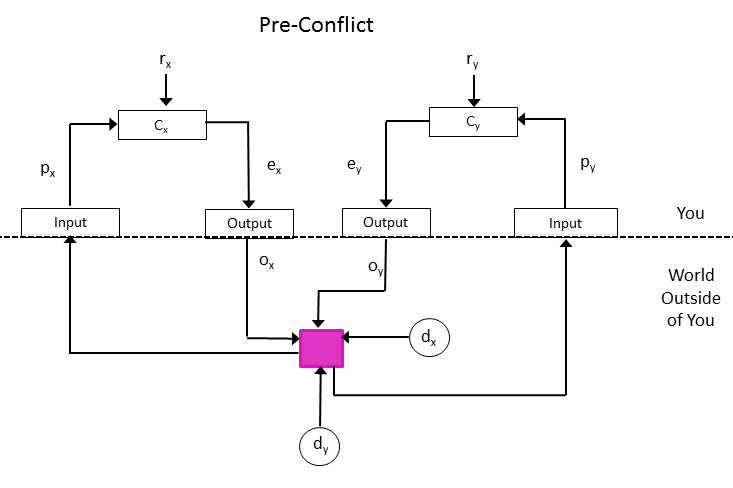
In this demo, your highest level goal is to keep the square at a particular location on the screen -- in this case, at the intersection of the blue lines (though you could have tried to keep it anywhere in the 2 D display space). In order to do this you had to control the positoin of the square in the horizontal (x) and vertical (y) dimensions of the display. A diagram of the control systems inside of you that are required to accomplish this task is shown below:
There is no conflict between the two control systems in the diagram above because each control system produces independent outputs (mouse movements, o.x and o.y) that can compensate for the disturbances, d.x and d.y, to the position of the square in each dimension. This was the case for the first 20 seconds of the test trial. During that time you could keep the cursor over the intersection of the blue lines (or anywhere else on the display, for that matter) because mouse movements in the x dimension, o.x, could compensate disturbances to the square in the x dimension and, at the same time, mouse movements in the y dimension, o.y, could compensate disturbances to the square in the y dimension. However, after 20 seconds the computer changed the connection of the mouse to the square so that movements of the mouse in the x and y dimension no longer had independent effects on the x and y position of the square. This was accomplished by having movements of the mouse in the x dimension, o.x, affect the square in both the x and y dimensions and by having movements of the mouse in the y dimension, o.y, also affect the square in both the y and x dimensions. Functionally, this means that two control systems are each controlling their perception with only one output, which could be called o.v for “virtual output”. The situation is shown in the diagram below:
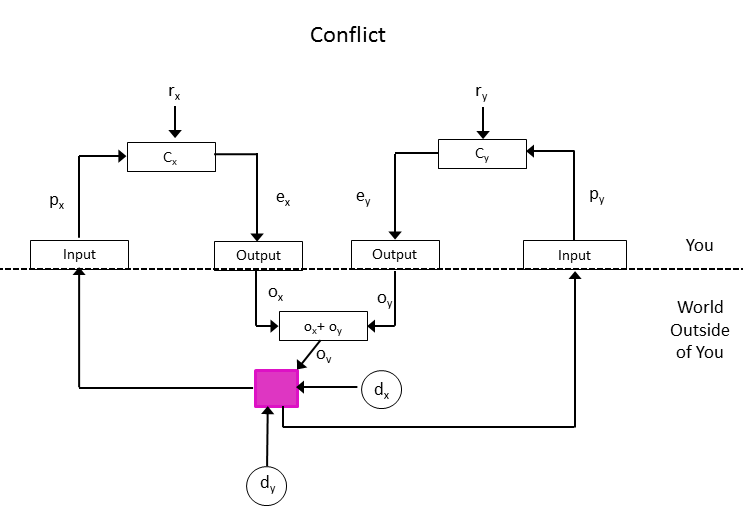
In order to keep the square at the intersection of the blue lines it is necessary to control the square in both the x and y dimensions. In order to do this it is necessary to be able to counter disturbances to the square in both the x and y dimensions
The conflict in this demo – like all conflicts -- is experienced as an inability to keep things under control – in this case, as an inability to keep the square “on target” at the intersection of the blue lines. You are unable to “push back” against disturbances -- the forces that are pushing the square away from the target in the x and y dimensions. It feels like you are immobilized; indeed, it can feel like events int he "World Outside of You" -- the disturbances pushing on the square -- are controlling you, rather than vice versa. When you are in conflict you feel like things are
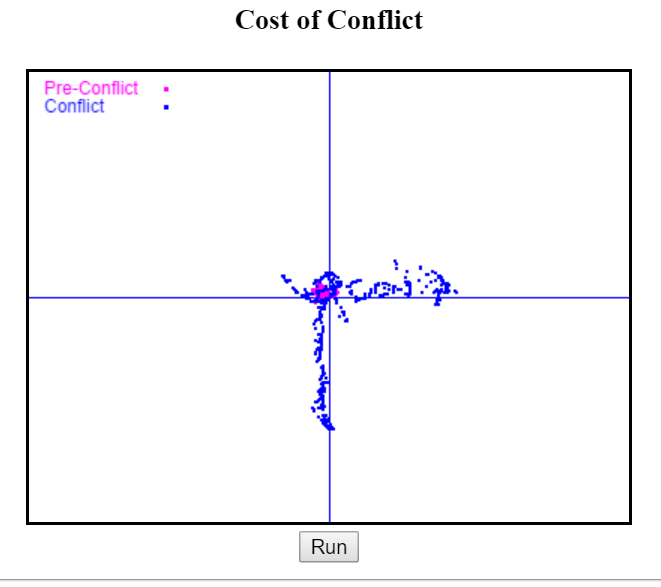
At the end of a trial you will see a graph showing the position of the square before (pink squares) and during (blue squares) the conflict. In the pre-conflict period the pink squares (which may be slightly obscured by the blue ones) hover close to the target intersection of the blue lines. During the conflict the blue squares will typically trace out a diagonal swath. This will happen as long as you kept trying to keep the square on target throughout the conflict period. The diagonal trace results from the fact that your virtual output, o.v, was able to compensate for the disturbances, d.x and d.y, when they pushed the square off the diagonal. This single virtual output just couldn’t compensate for the disturbances that required values of o.v that were off the diagonal. That is, when the systems controlling for p.x and p.y had to have o.v at two different values at the same time – two values that o.v couldn’t be in at the same time.
Another way of looking at the conflict demo is as follows: When o.v is your only way of affecting the position of the square, your attempts to reduce e.x, the deviation of the square from the zero point on the x axis, increases e.y, the deviation of the square from the zero point on the y axis, and at the same your attempts to reduce e.y increases e.x. So you -- the two control systems within you – are, literally, fighting against yourself.
There is no clever way to solve conflicts like this, if, by solution, one means figuring out a way for the systems in conflict to get what they want. In this demo, such a solution would mean finding a way to keep the square on target during the conflict period. If you were able to do this it would mean that the systems controlling the position of the square are managing to simultaneously keep their perceptions, p.x and p.y, at r.x and r.y, respectively. But such a “solution” is physically impossible. Try as you might during the conflict period, there is simply no way to move the mouse so that the square stays on target.
Perceptual Control Theory (PCT) suggests that the only way to “solve” conflicts such as this is by changing our goals (the references r.x and r.y) that cause them. The conflict in this demo results from the fact that you are trying to achieve two goals – getting the square aligned with the 0 point on both the x and y axis at the same time -- that have become impossible to achieve in this environment (thanks to the computer combining o.x and o.y into one virtual output, o.v). Changing goals requires that you become aware of why you are setting those goals in the first place. According to PCT you set goals to satisfy higher level goals. So changing goals requires becoming aware of the higher level goals that are creating the lower level goal. This is called “going up a level” and is the basis of a therapeutic technique based on PCT called the
In this demo the higher level goal that created the conflict producing goals was the goal of keeping the square at the intersection of the blue lines. Achieving this goal required that you simultaneously control the x and y position of the square. It you change this higher level goal to something like “keep the square aligned with only one axis at a time” you will find that there is no longer a conflict. With only one output you should be able to keep the square aligned with the 0 point on the x axis while ignoring the fact that it drifts up and down along the y axis; or you can keep the square aligned with the 0 point on the y axis while ignoring the fact that it drifts left and right along the x axis. Indeed, you can achieve one goal and then the other during one conflict session. The result of doing this is shown in the screen shot below.
In this example, after the pre-conflict session, I kept the square aligned with the 0 point on the x axis (p.x was kept at r.x = 0) while ignoring the vertical drift of the square (p.y was left uncontrolled). This is seen in the vertical cluster of blue dots clinging close to the y axis (the 0 point on the x axis). After about 20 seconds I shifted to keeping the square aligned with the 0 point on the y axis (p.y was kept at r.y = 0) while ignoring the horizontal drift of the square (p.y was left uncontrolled). This is seen in the horizontal cluster of blue dots clinging close to the x axis (the 0 point on the y axis). This illustrates one of the most common “solutions” to a conflict; rather than controlling for the conflicted goals simultaneously, simply achieve them in sequence. If you can’t have your cake and eat it at the same time, first control for having it and then for eating it.
This demonstration works best if you try very hard to keep the square over the intersectoin point of the blue lines even when this has become impossible due to the existence of the conflict. This may be hard to do because, as noted above, being in a conflict is very stressful. But it’s worth trying to stay in the conflict – continue to try to keep the square on target even while this is impossible -- since you really do get a better feeling for what it’s like to be in a conflict – and for the true cost of conflict -- if you experience the frustrating reality of being in one for a while.
Last Modified: March, 2016
What Works Best
marken@mindreadings.com